
The short answer
A state electricity average is an aggregate for a period, not your utility tariff. Estimate your bill using your own consumption, applicable variable rates, fixed charges and other bill components.
Begin with the units
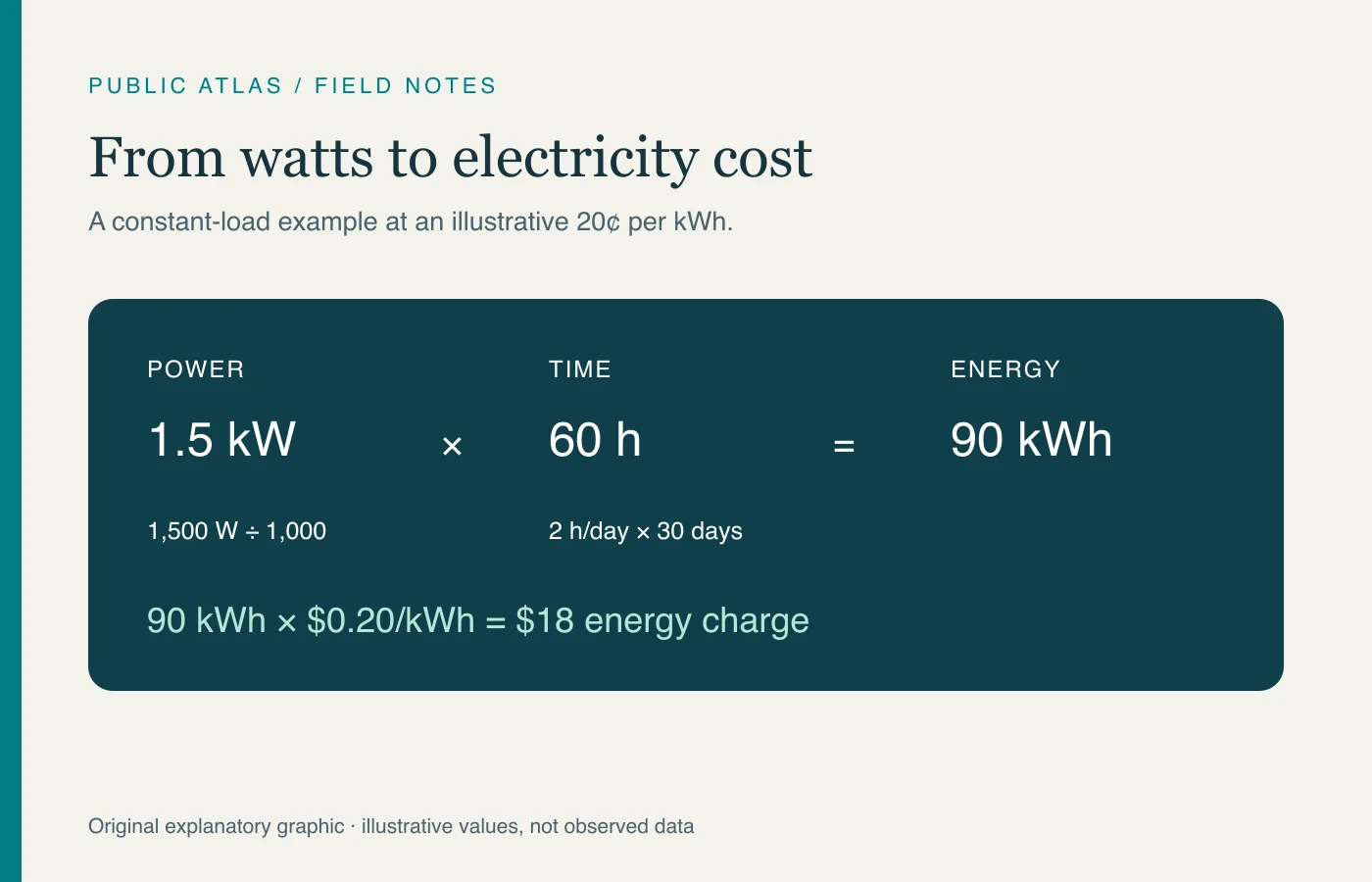
A kilowatt (kW) describes power; a kilowatt-hour (kWh) describes energy used over time. If an appliance draws a constant 1 kW for one hour, it uses 1 kWh. Real appliances may cycle on and off, so a nameplate wattage multiplied by elapsed time can overstate or otherwise miss actual use.
A price in cents per kWh can be converted to dollars per kWh by dividing by 100. Use the relevant billing period and the rate for the electricity you expect to use. Check whether a quoted rate includes supply and delivery or only one component.
What a state average can and cannot show
The U.S. Energy Information Administration publishes electricity sales and average price data by state and customer sector. The residential average describes an aggregate for a specified geography and period; it is not a personalized quote, a live tariff or a promise that every household paid that amount.
When comparing two published averages, check the year or month, sector, units and whether the underlying series has been revised. A state’s annual average and a household’s single-month bill have different scopes. For your own estimate, start with your utility’s current rate schedule and the terms of your plan.
A modeled bill with a fixed charge

Suppose a household uses 600 kWh in a fictional billing month, pays 18 cents per kWh for the combined variable charges, and has a $15 fixed charge. The variable component is 600 × $0.18 = $108. Adding the fixed charge gives $123 before any other fees, taxes, credits or tier changes.
Dividing $123 by 600 kWh gives an effective average of 20.5 cents per kWh for this simplified bill. That is different from the 18-cent variable rate because the fixed charge is included. All values are invented for arithmetic, not current utility prices.
Why an appliance estimate is not the bill
Imagine an appliance actually consumes 1.2 kWh per day for 30 days. Its modeled consumption is 36 kWh. At a flat 18 cents per kWh, the additional variable energy charge would be $6.48. This assumes a constant applicable rate and no change to the fixed charge.
Do not assign the entire $15 household fixed charge to this one appliance as if it disappeared when the appliance was switched off. Conversely, a time-of-use plan, tier threshold, demand charge or other pricing rule can change the actual incremental cost. Check your tariff and billing details before claiming a saving.
Match the comparison to the decision

For a broad regional comparison, the same EIA series, customer sector and year can offer context. For planning a household budget, use your own expected kWh, utility rates and fixed charges. For an appliance decision, use measured or carefully estimated consumption and the rate that applies when it runs.
A bill divided by usage is an average of that bill’s included charges; it may not be the marginal price of the next kWh. Separate delivery and supply where your bill does so, and note the dates, credits and assumptions. If the tariff is unclear, ask the utility for the current rate schedule.
Make the calculation repeatable
Keep a simple record: appliance or household, measured or assumed kWh, time period, price in cents per kWh, fixed charges, taxes and exclusions. Record the EIA data period separately from the date you retrieved it.
Use Public Atlas’s calculator for an estimate, then compare its assumptions with the bill. It does not know your exact tariff, future usage or utility adjustments. Update the inputs when the rate, season or operating pattern changes.
Make a side-by-side worksheet
Write the billing period and actual consumption first. List the variable supply and delivery rates, any tiers or time periods, the fixed service charge, taxes and other items. Compute each line using the utility’s rules. Keep a separate column for credits or payments that are not a usage charge.
In another column, record the EIA geography, customer sector, reporting period and average in cents per kWh. Label it “context,” not “my rate.” For a device, add measured kWh if available, or show its wattage, operating hours and assumptions. Update the worksheet when your tariff or use changes.
A quick check before sharing an estimate
Put the billing period next to the total and use cents or dollars consistently. State whether the estimate includes supply, delivery, fixed fees, taxes, credits and time-of-use periods. If an appliance’s power varies, distinguish measured energy from an estimate based on rated wattage and hours.
A state average can help describe a broad pattern but should not be presented as an available household tariff. Keep a link to the EIA series and the reporting year, and use the utility’s current tariff for an actual customer decision. If information is missing, show the range of plausible costs rather than presenting a single precise figure.
Your next steps
- Record the billing period and consumption in kWh.
- Identify your tariff’s variable, fixed and other charges.
- Label a state average with the geography, sector and reporting period.
- Use a matched tariff or measured appliance usage for your own estimate.
Common questions
does a bill divided by kWh equal my next-kWh price?
Not necessarily. Dividing the total billed amount by usage gives an average for that bill and its included charges. It can include fixed charges, taxes, credits or fees. The price of one additional kWh is governed by the applicable tariff and may depend on the time or usage tier. For a rough budget, an all-in average may be useful if you state its period and components. For an appliance or efficiency decision, look for the variable charges that would change with its consumption. A rate schedule or utility representative can help you identify the applicable components.
which state average should I choose?
Use a series matching the question: residential rather than all sectors if you are exploring household context, and the same reporting period when comparing places. EIA provides monthly and annual data; a recent monthly figure and an annual average answer different questions. Check the source description, date, units and revision status. The most recently downloaded file can still describe an earlier reporting period. An aggregate is a useful benchmark, but your utility, tariff, billing period and consumption pattern determine your own charges.
Sources and editorial record
- EIA: State electricity sales and price data
- EIA: Measuring electricity
- Department of Energy: Understanding utility rate options
Prepared with AI assistance from the linked sources. Independent human review pending. “Public Atlas Editorial” is a publication label. First edition: 2026-10-28. Scheduled source review: 2027-01-28. Data examples update with their source snapshots; the guide text is versioned separately.
Changes to this guide
- 2026-10-28 — First AI-assisted edition published after source checks, with human review pending.