The short answer
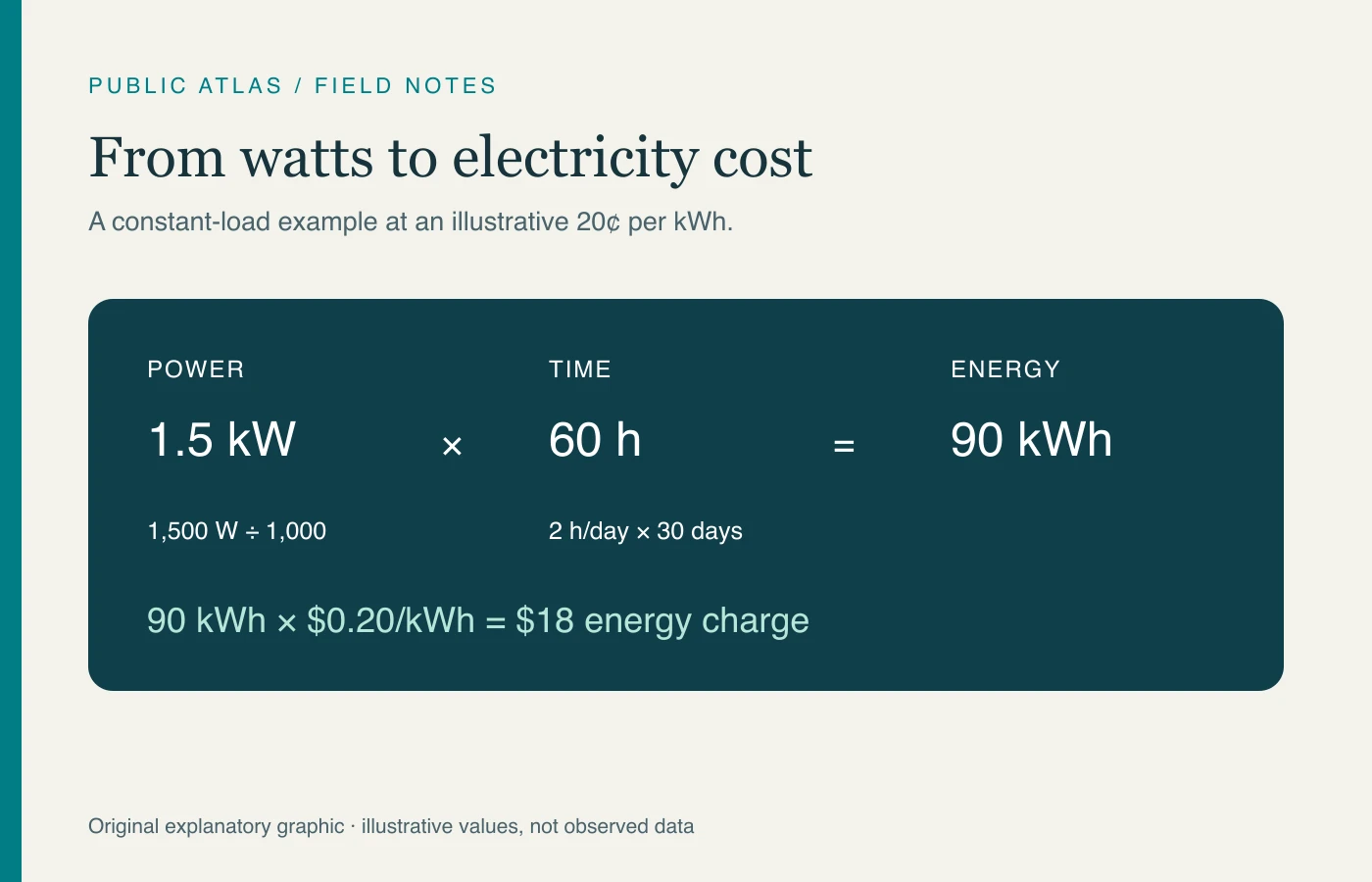
Electricity cost = watts ÷ 1,000 × hours used × price per kWh. At an illustrative $0.20/kWh, a constant 1,500-watt load used for two hours costs $0.60. Repeating that use for 30 days costs $18 in energy charges.
Collect three inputs before calculating
You need the appliance’s power draw in watts, its operating time and your price per kilowatt-hour. Virginia Cooperative Extension describes this calculation and explains that actual consumption can vary with settings. A maximum nameplate rating is not necessarily the average draw throughout a day. Use measured consumption when it is available.
Work through a 30-day example
Suppose a device draws a constant 1,500 watts for two hours every day. Divide by 1,000 to get 1.5 kilowatts. Multiply by two hours to get 3 kWh daily, then by 30 days to get 90 kWh. At a hypothetical 20 cents per kWh, calculate 90 × 0.20 = $18. The example assumes the same load and schedule every day; it is not an estimate for a particular appliance model or household.
Do not confuse cents and dollars
If your bill lists 20 cents/kWh, enter 20 in a cents field or 0.20 in a dollars field. Entering 20 dollars instead makes an estimate 100 times too high. Our calculator labels its price in cents per kWh. Write the unit next to a copied result so someone else can reproduce it without guessing.
Compare two operating schedules
At the same illustrative 1,500 watts and 20 cents/kWh, one hour costs $0.30. Two hours each day over 30 days cost $18; four hours each day cost $36. That $18 difference follows from the assumed runtime. It does not predict what a thermostat-controlled device will actually consume. Test a plausible low and high runtime in the calculator rather than presenting one uncertain input as exact.
Which electricity rate should you use?
Use the applicable energy rate from your tariff for a personal estimate. The calculator also offers dated EIA annual residential averages for state comparisons. Those are aggregate historical prices, not a current supplier offer. If your tariff changes by time period, calculate usage in each period separately and add the results. Check the tariff itself before assuming night-time usage costs less.
Why your bill can still be different
This calculation estimates the energy charge for the usage you enter. A household bill can also reflect other appliances, fixed charges, taxes and tariff terms. A 30-day example is not a calendar-month forecast. For an annual constant-use illustration, multiply the daily usage by 365 rather than multiplying a 30-day amount by twelve.
Your next steps
- Find your applicable tariff rate and check whether it is in cents or dollars.
- Use operating watts and hours, or measured kWh if available.
- Calculate a realistic low and high usage scenario.
- Keep fixed charges and other bill items separate from the appliance estimate.
Common questions
How much does a 1,500-watt appliance cost per hour?
At a constant 1,500 watts it uses 1.5 kWh in one hour. Multiply 1.5 by your price in dollars per kWh: at an illustrative $0.20/kWh, that is $0.30.
How do I calculate electricity cost per month?
Multiply watts ÷ 1,000 by operating hours per day, days of use and your price per kWh. For several devices, calculate each separately. This gives an energy-use estimate, not necessarily your total bill.
Can I use the state average as my electricity rate?
Use it as historical comparison context. For an estimate of your own usage charge, use the relevant rate and terms from your utility bill. EIA averages are not individual tariffs.
Sources and editorial record
Prepared with AI assistance from the linked sources. Independent human review pending. “Public Atlas Editorial” is a publication label. First edition: 2026-10-16. Scheduled source review: 2027-01-16. Data examples update with their source snapshots; the guide text is versioned separately.
Changes to this guide
- 2026-10-16 — Published an AI-assisted, source-linked explanation with original worked examples. Human editorial review remains pending.