The short answer
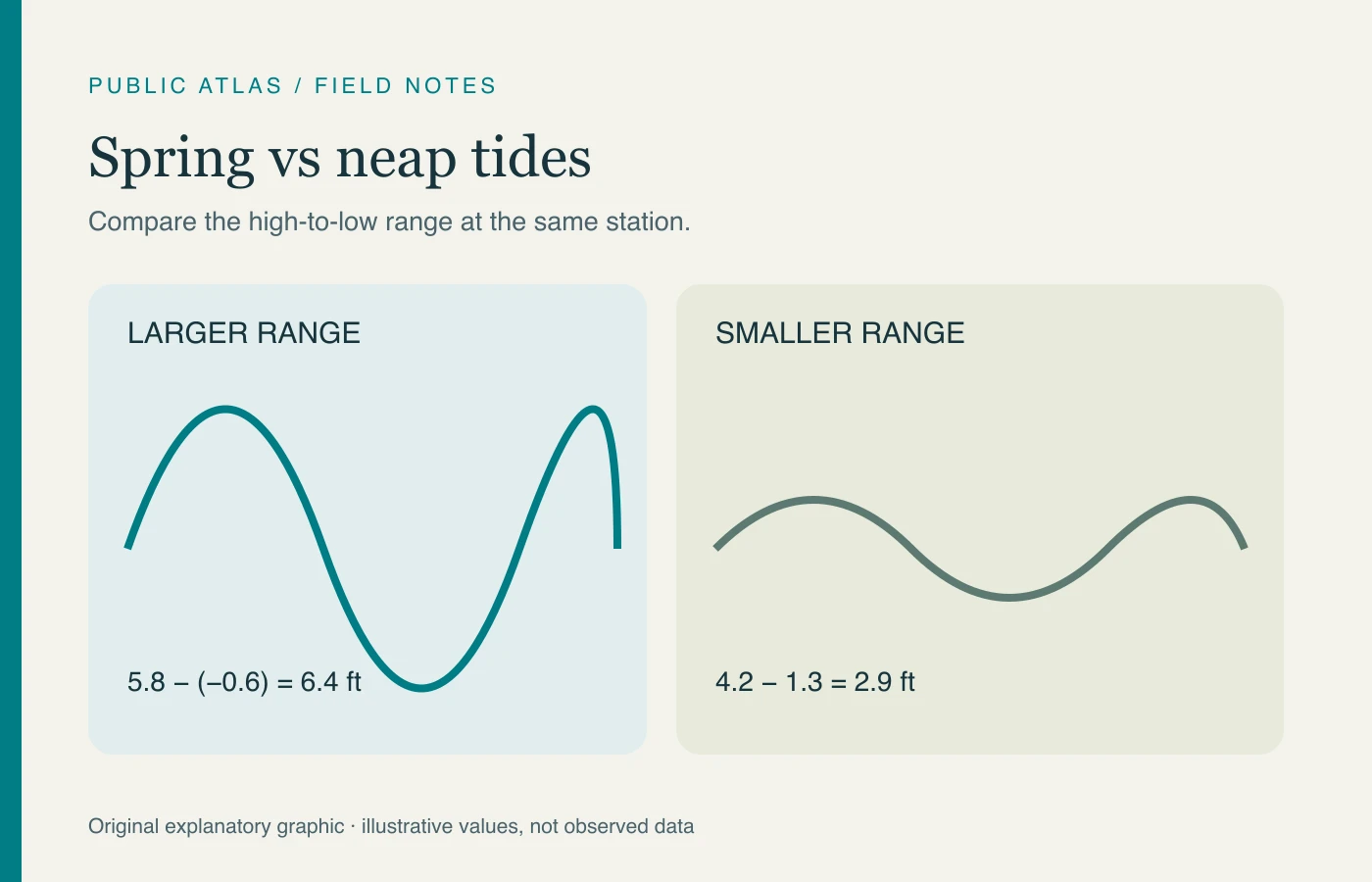
Spring tides have a larger high-to-low range around new and full moons. Neap tides have a smaller range around first- and third-quarter moons. Neither term tells you the exact tide time at your beach; use a local station’s dated predictions.
What is the difference between spring and neap tides?
NOAA explains that the Sun and Moon reinforce the tidal effect when nearly aligned, producing spring tides. Around quarter moons their effects partly offset, producing neap tides. “Spring” refers to the water springing forth, not the season. Both happen throughout the year.
Read the range, not just the high-water number
Subtract a low-water height from an adjacent high-water height measured at the same station and datum. In our fictional example, a high of 5.8 feet and low of −0.6 feet give a range of 6.4 feet. A different day with a 4.2-foot high and 1.3-foot low gives 2.9 feet. The first pair has the larger excursion. These invented values demonstrate subtraction; they are not predictions for a beach.
How to tell what your local chart is showing
Start with one station and compare several days, rather than switching stations between readings. Keep the height unit and datum unchanged. If there are two high tides in a day, compare adjacent highs and lows instead of treating one number as the whole day. A larger range in one pair does not, by itself, establish the lunar phase or a safe access window.
When is the next spring or neap tide?
New and full moons are the broad guide to spring tides; quarter moons are the guide to neaps. For a trip, the actionable question is the predicted high and low water at your chosen station and date. Open the planner, verify the prediction coverage, and consult NOAA directly if your date is outside the available snapshot. Do not reuse last month’s tide times.
A worked planning check
Imagine comparing two potential beach visits. Record each date, station ID, low-water time, height unit and datum. Then check whether the station actually represents the beach. For example, a station across an inlet is not automatically interchangeable with the shore you plan to visit. Use our station-selection guide and the official local access information before choosing your visit.
What the lunar label cannot answer
The lunar phase does not tell you whether a route is open, whether waves will reach a particular rock, or when the current will be slack. Our tide planner is a way to inspect dated predictions. It does not classify a route as safe. Keep local weather, water-level observations and access notices alongside the tide table.
Your next steps
- Choose a station that represents your destination.
- Check the prediction date range, time zone and height datum.
- Compare adjacent high and low heights at that same station.
- Check official local access and weather information before leaving.
Common questions
What is the opposite of a neap tide?
A spring tide is the contrasting phase: it has a larger tidal range, whereas a neap tide has a smaller range.
When does a neap tide occur?
Around the first and third quarters of the Moon, roughly a week after the spring-tide part of the cycle.
Are spring tides only in spring?
No. They occur through the year around new and full moons. The name does not refer to the season.
Sources and editorial record
Prepared with AI assistance from the linked sources. Independent human review pending. “Public Atlas Editorial” is a publication label. First edition: 2026-10-16. Scheduled source review: 2027-01-16. Data examples update with their source snapshots; the guide text is versioned separately.
Changes to this guide
- 2026-10-16 — Published an AI-assisted, source-linked explanation with original worked examples. Human editorial review remains pending.